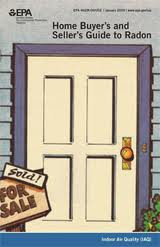
Home Buyer's and Seller's Guide to Radon
- If you are buying a home or selling your home, have
it tested for radon.
- For a new home, ask if radon-resistant construction
features were used and if the home has been tested.
- Fix the home if the radon level is 4 picoCuries
per liter (pCi/L) or higher.
- Radon levels less than 4 pCi/L still pose a risk,
and in many cases, may be reduced.
- Take steps to prevent device interference when conducting
a radon tes
EPA estimates that radon causes thousands of cancer deaths
in the U.S. each year.
* Radon is estimated to cause about 21,000 lung cancer
deaths per year.
The numbers of deaths from other causes are taken from
the Centers for Disease Control and Prevention's 1999-2001
National Center for Injury Prevention and Control Report
and 2002 National Safety Council Reports
Radon Is a Cancer-Causing, Radioactive Gas
You cannot see, smell, or taste radon. But it still may
be a problem in your home. When you breathe air containing
radon, you increase your risk of getting lung cancer. In
fact, the Surgeon General of the United States has warned
that radon is the second leading cause of lung cancer in
the United States today. If you smoke and your home has
high radon levels, your risk of lung cancer is especially
high.
You Should Test for Radon
Testing is the only way to find out your home's radon
levels. EPA and the Surgeon General recommend testing all
homes below the third floor for radon.
You Can Fix a Radon Problem
If you find that you have high radon levels, there are
ways to fix a radon problem. Even very high levels can be
reduced to acceptable levels.
If You Are Selling a Home...
EPA recommends that you test your home before putting
it on the market and, if necessary, lower your radon levels.
Save the test results and all information you have about
steps that were taken to fix any problems. This could be
a positive selling point.
If You Are Buying a Home...
EPA recommends that you know what the indoor radon level
is in any home you consider buying. Ask the seller for their
radon test results. If the home has a radon-reduction system,
ask the seller for information they have about the system.
If the home has not yet been tested, you should have
the housed tested.
If you are having a new home built, there are features
that can be incorporated into your home during construction
to reduce radon levels.
The radon testing guidelines in this Guide have been
developed specifically to deal with the time-sensitive nature
of home purchases and sales, and the potential for radon
device interference. These guidelines are slightly different
from the guidelines in other EPA publications which provide
radon testing and reduction information for non-real estate
situations.
This Guide recommends three short-term testing options
for real estate transactions. EPA also recommends testing
a home in the lowest level which is currently suitable for
occupancy, since a buyer may choose to live in a lower area
of the home than that used by the seller.
1. Why Do You Need to Test for Radon?
a.
 Radon
Has Been Found In Homes All Over the U.S.
Radon
Has Been Found In Homes All Over the U.S.
Radon is a radioactive gas that has been found in homes
all over the United States. It comes from the natural breakdown
of uranium in soil, rock and water and gets into the air
you breathe. Radon typically moves up through the ground
to the air above and into your home through cracks and other
holes in the foundation. Radon can also enter your home
through well water. Your home can trap radon inside.
Any home can have a radon problem. This means new and
old homes, well-sealed and drafty homes, and homes with
or without basements. In fact, you and your family are most
likely to get your greatest radiation exposure at home.
That is where you spend most of your time.
Nearly 1 out of every 15 homes in the United States is
estimated to have an elevated radon level (4 pCi/L or more).
Elevated levels of radon gas have been found in homes in
your state.
b. EPA and the Surgeon General Recommend That You
Test Your Home
Testing is the only way to know if you and your family
are at risk from radon. EPA and the Surgeon General recommend
testing all homes below the third floor for radon.
 You
cannot predict radon levels based on state, local, and neighborhood
radon measurements. Do not rely on radon test results taken
in other homes in the neighborhood to estimate the radon
level in your home. Homes which are next to each other can
have different radon levels. Testing is the only way to
find out what your home's radon level is.
You
cannot predict radon levels based on state, local, and neighborhood
radon measurements. Do not rely on radon test results taken
in other homes in the neighborhood to estimate the radon
level in your home. Homes which are next to each other can
have different radon levels. Testing is the only way to
find out what your home's radon level is.
In some areas, companies may offer different types of
radon service agreements. Some agreements let you pay a
one-time fee that covers both testing and radon mitigation,
if needed.
U.S. Surgeon General Health Advisory
"Indoor radon gas is the second-leading cause of lung
cancer in the United States and breathing it over prolonged
periods can present a significant health risk to families
all over the country. It's important to know that this threat
is completely preventable. Radon can be detected with a
simple test and fixed through well-established venting techniques."
January 2005
2. I'm Selling a Home. What Should I Do?
a. If Your Home Has Already Been Tested for Radon...
If you are thinking of selling your home and you have
already tested your home for radon, review the Radon Testing
Checklist to make sure that the test was done correctly.
If so, provide your test results to the buyer.
No matter what kind of test you took, a potential buyer
may ask for a new test especially if:
- The Radon Testing Checklist items were not met;
- The last test is not recent, e.g., within two years;
- You have renovated or altered your home since you
tested; or
- The buyer plans to live in a lower level of the
house than was tested, such as a basement suitable for
occupancy but not currently lived in.
A buyer may also ask for a new test if your state or
local government requires disclosure of radon information
to buyers.
b. If Your Home Has Not Yet Been Tested for Radon...
Have a test taken as soon as possible. If you can, test
your home before putting it on the market. You should test
in the lowest level of the home which is suitable for occupancy.
This means testing in the lowest level that you currently
live in or a lower level not currently used, but which a
buyer could use for living space without renovations.
The radon test result is important information
about your home's radon level. Some states require radon
measurement testers to follow a specific testing protocol.
If you do the test yourself, you should carefully follow
the testing protocol for your area or EPA's Radon Testing
Checklist. If you hire a contractor to test your residence,
protect yourself by hiring a qualified individual or company.
You can determine a service provider's qualifications
to perform radon measurements or to mitigate your home in
several ways. Many states require radon professionals to
be licensed, certified, or registered. Most states can provide
you with a list of knowledgeable radon service providers
doing business in the state. In states that don't regulate
radon services, ask the contractor if they hold a professional
proficiency or certification credential.Such programs usually
provide members with a photo-ID card, which indicates their
qualification(s) and its expiration date. If in doubt, you
should check with their credentialing organization. Alternatively,
ask the contractor if they've successfully completed formal
training appropriate for testing or mitigation, e.g., a
course in radon measurement or radon mitigation.
3. I'm Buying a Home. What Should I Do?
a. If the Home Has Already Been Tested for Radon...
If you are thinking of buying a home, you may decide
to accept an earlier test result from the seller, or ask
the seller for a new test to be conducted by a qualified
radon tester. Before you accept the seller's test, you should
determinethe results of previous testing;
-
Who conducted the previous test: the homeowner, a
radon professional, or some other person
-
Where in the home the previous test was taken, especially
if you may plan to live in a lower level of the home.
For example, the test may have been taken on the first
floor. However, if you want to use the basement as living
space, test there...
-
What, if any, structural changes, alterations, or
changes in the heating, ventilation, and air conditioning
(HVAC) system have been made to the house since the
test was done. Such changes may affect radon levels.
If you accept the seller's test, make sure that the test
followed the Radon Testing Checklist.
If you decide that a new test is needed, discuss it with
the seller as soon as possible.
b. If the Home Has Not Yet Been Tested for Radon...
Make sure that a radon test is done as soon as
possible. Consider including provisions in the contract
specifying:
- Where the test will be located?
- Who should conduct the test?
- What type of test to do?
- When to do the test ?
- How the seller and the buyer will share the test
results and test costs (if necessary)
- When radon mitigation measures will be taken and
who will pay for them.
Make sure that the test is done in the lowest level of
the home suitable for occupancy. This means the lowest level
that you are going to use as living space which is finished
or does not require renovations prior to use. A state or
local radon official or qualified radon tester can help
you make some of these decisions.If you decide to finish
or renovate an unfinished area of the home in the future,
a radon test should be taken before starting the project
and after the project is finished. Generally, it is less
expensive to install a radon-reduction system before (or
during) renovations rather than afterwards.
4. I'm Buying or Building a New Home. How Can I Protect
My Family?
a. Why Should I Buy a Radon-Resistant Home?
Radon-resistant techniques work. When installed properly
and completely, these simple and inexpensive passive techniques
can help to reduce radon levels. In addition, installing
them at the time of construction makes it easier to reduce
radon levels further if the passive techniques don't reduce
radon levels below 4 pCi/L. Radon-resistant techniques may
also help to lower moisture levels and those of other soil-gases.
Radon-resistant techniques:
Making Upgrading Easy: Even if built to be radon-resistant,
every new home should be tested for radon after occupancy.
If you have a test result of 4 pCi/L or more, a vent fan
can easily be added to the passive system to make it an
active system and further reduce radon levels.
Are Cost-Effective: Building radon-resistant features
into the house during construction is easier and cheaper
than fixing a radon problem from scratch later. Let your
builder know that radon-resistant features are easy to install
using common building materials.
Save Money: When installed properly and completely, radon-resistant
techniques can also make your home more energy efficient
and help you save on your energy costs.
In a new home, the cost to install passive radon-resistant
features during construction is usually between $350 and
$500. In some areas, the cost may be as low as $100. A qualified
mitigator will charge about $300 to add a vent fan to a
passive system, making it an active system and further reducing
radon levels. In an existing home, it usually costs between
$800 and $2,500 to install a radon mitigation system.
 b.
What Are Radon-Resistant Features?
b.
What Are Radon-Resistant Features?
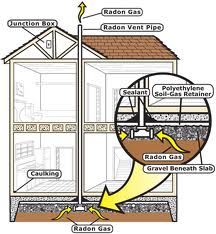
Radon-resistant techniques (features) may vary for different
foundations and site requirements. If you're having a house
built, you can learn about EPA's Model Standards (and architectural
drawings) and explain the techniques to your builder. If
your new house was built (or will be built) to be radon-resistant,
it will include these basic elements:
-
Gas-Permeable Layer: This layer is placed beneath
the slab or flooring system to allow the soil gas to
move freely underneath the house. In many cases, the
material used is a 4-inch layer of clean gravel. This
gas-permeable layer is used only in homes with basement
and slab-on-grade foundations; it is not used in homes
with crawlspace foundations.
-
Plastic Sheeting: Plastic sheeting is placed on top
of the gas-permeable layer and under the slab to help
prevent the soil gas from entering the home. In crawl
spaces, the sheeting (with seams sealed) is placed directly
over the crawlspace floor.
-
Sealing and Caulking: All below-grade openings in
the foundation and walls are sealed to reduce soil gas
entry into the home.
-
Vent Pipe: A 3- or 4-inch PVC pipe (or other gas-tight
pipe) runs from the gas-permeable layer through the
house to the roof, to safely vent radon and other soil
gases to the outside.
-
Junction Boxes: An electrical junction box is included
in the attic to make the wiring and installation of
a vent fan easier. For example, you decide to activate
the passive system because your test result showed an
elevated radon level (4 pCi/L or more). A separate junction
box is placed in the living space to power the vent
fan alarm. An alarm is installed along with the vent
fan to indicate when the vent fan is not operating properly.
5. How Can I Get Reliable Radon Test Results?
Radon testing is easy and the only way to find out if
you have a radon problem in your home.
a. Types of Radon Devices
Since you cannot see or smell radon, special equipment
is needed to detect it. When you're ready to test your home,
you can order a radon test kit by mail from a qualified
radon measurement services provider or laboratory. You can
also hire a qualified radon tester, very often a home inspector,
who will use a radon device(s) suitable to your situation.
The most common types of radon testing devices are listed
below.
Passive Devices
Passive radon testing devices do not need power to function.
These include charcoal canisters, alpha-track detectors,
charcoal liquid scintillation devices, and electret ion
chamber detectors which are available in hardware, drug,
and other stores; they can also be ordered by mail or phone.
These devices are exposed to the air in the home for a specified
period of time and then sent to a laboratory for analysis.
Both short-term and long-term passive devices are generally
inexpensive. Some of these devices may have features that
offer more resistance to test interference or disturbance
than other passive devices. Qualified radon testers may
use any of these devices to measure the home's radon level.
Active Devices
Active radon testing devices require power to function.
These include continuous radon monitors and continuous working
level monitors. They continuously measure and record the
amount of radon or its decay products in the air. Many of
these devices provide a report of this information which
can reveal any unusual or abnormal swings in the radon level
during the test period. A qualified tester can explain this
report to you. In addition, some of these devices are specifically
designed to deter and detect test interference. Some technically
advanced active devices offer anti-interference features.
Although these tests may cost more, they may ensure a more
reliable result.
b. General Information for All Devices
A state or local radon official can explain the differences
between devices and recommend the ones which are most appropriate
for your needs and expected testing conditions.
Make sure to use a radon measurement device from a qualified
laboratory. Certain precautions should be followed to avoid
interference during the test period. See the Radon Testing
Checklist for more information on how to get a reliable
test result.
Radon Test Device Placement
EPA recommends that testing device(s) be placed in the
lowest level of the home suitable for occupancy. This means
testing in the lowest level (such as a basement), which
a buyer could use for living space without renovations.
The test should be conducted in a room to be used regularly
(like a family room, living room, playroom, den or bedroom);
do not test in a kitchen, bathroom, laundry room or hallway.
Usually, the buyer decides where to locate the radon test,
based on their expected use of the home. A buyer and seller
should explicitly discuss and agree on the test location
to avoid any misunderstanding. Their decision should be
clearly communicated to the person performing the test.
c. Preventing or Detecting Test Interference
There is a potential for test interference in real estate
transactions. There are several ways to prevent or detect
test interference:
- Use a test device that frequently records radon
or decay product levels to detect unusual swings
- Employ a motion detector to determine whether the
test device has been moved or testing conditions have
changed
- Use a proximity detector to reveal the presence
of people in the room which may correlate to possible
changes in radon levels during the test
- Record the barometric pressure to identify weather
conditions which may have affected the test
- Record the temperature record to help assess whether
doors and windows have been opened
- Apply tamper-proof seals to windows to ensure closed
house conditions
- Have the seller/occupant sign a non-interference
agreement
Home buyers and sellers should consult a qualified radon
test provider about the use of these precautions.
d. Length of Time to Test
There Are Two General Ways To Test Your Home for Radon:
Because radon levels vary from day to day and season
to season, a short-term test is less likely than a long-term
test to tell you your year-round average radon level. However,
if you need results quickly, a short-term test may be used
to decide whether to fix the home.
Short-Term Testing
The quickest way to test is with short-term tests. Short-term
tests remain in your home from two days to 90 days, depending
on the device. There are two groups of devices which are
more commonly used for short-term testing. The passive device
group includes alpha track detectors, charcoal canisters,
charcoal liquid scintillation detectors, and electret ion
chambers. The active device group consists of different
types of continuous monitors.
| Whether you test
for radon yourself or hire a state-certified tester
or a privately certified tester, all radon tests
should be taken for a minimum of 48 hours. A longer
period of testing is required for some devices. |
Long-term tests remain in your home for more than 90
days. Alpha track, and electret ion chamber detectors are
commonly used for this type of testing. A long-term test
will give you a reading that is more likely to tell you
your home's year-round average radon level than a short-term
test. If time permits (more than 90 days) long-term tests
can be used to confirm initial short-term results. When
long-term test results are 4 pCi/L or higher, EPA recommends
fixing the home.
e. Doing a Short-Term Test...
If you are testing in a real estate transaction and you
need results quickly, any of the following three options
for short-term Tests are acceptable in determining whether
the home should be fixed. Any real estate test for radon
should include steps to prevent or detect device interference
with the test device.
|
When Choosing a Short-Term Testing
Option...
There are trade-offs among the short-term testing
options. Two tests taken at the same time (simultaneous)
would improve the precision of this radon test.
One test followed by another test (sequential) would
most likely give a better representation of the
seasonal average. Both active and passive devices
may have features which help to prevent test interference.
Your state radon office can help you decide which
option is best.
|
| Short-Term Testing
Options |
What to do Next |
Passive:
Take two short-term tests at the same time in the
same location for at least 48 hours.
or
Take an initial short-term test for at least
48 hours. Immediately upon completing the first
test, do a second test using an identical device
in the same location as the first test.
|
Fix the home if the average of two tests is 4 pCi/L
or more.
Fix the home if the average of the two tests
is 4 pCi/L or more.
|
Active:
Test the home with a continuous monitor for at least
48 hours. |
Fix the home if the average radon level is 4 pCi/L
or more.
|
f. Using Testing Devices Properly for Reliable Results
If You Do the Test Yourself...
 When
you are taking a short-term test, close windows and doors
and keep them closed, except for normal entry and exit.
If you are taking a short-term test lasting less than four
days, be sure to:
When
you are taking a short-term test, close windows and doors
and keep them closed, except for normal entry and exit.
If you are taking a short-term test lasting less than four
days, be sure to:
- Close your windows and outside doors at least 12
hours before beginning the test;
- Do not conduct short-term tests lasting less than
four days during severe storms or periods of high winds;
- Follow the testing instructions and record the start
time and date;
- Place the test device at least 20 inches above the
floor in a location where it will not be disturbed and
where it will be away from drafts, high heat, high humidity,
and exterior walls;
- Leave the test kit in place for as long as the test
instructions say; and
- Once you have finished the test, record the stop
time and date, reseal the package and return it immediately
to the lab specified on the package for analysis.
You should receive your test results within a few weeks.
If you need results quickly, you should find out how long
results will take and, if necessary, request expedited service.
| |
If You Hire a Qualified Radon Tester
|
In many cases, home buyers and sellers may decide to
have the radon test done by a qualified radon tester who
knows the proper conditions, test devices, and guidelines
for obtaining a reliable radon test result. They can also:
- Evaluate the home and recommend a testing approach
designed to make sure you get reliable results;
- Explain how proper conditions can be maintained
during the radon test;
- Emphasize to occupants of a home that a reliable
test result depends on their cooperation. Interference
with, or disturbance of, the test or closed-house conditions
will invalidate the test result;
- Analyze the data and report measurement results;
and
- Provide an independent test.
g. Interpreting Radon Test Results
The average indoor radon level is estimated to be about
1.3 pCi/L; roughly 0.4 pCi/L of radon is normally found
in the outside air. The U.S. Congress has set a long-term
goal that indoor radon levels be no more than outdoor levels.
While this goal is not yet technologically achievable for
all homes, radon levels in many homes can be reduced to
2 pCi/L or below.
|
Radon Test Results Reported in
Two Ways
Your radon test results may be reported in either
picoCuries per liter of air (pCi/L) or working levels
(WL). If your test result is in pCi/L, EPA recommends
you fix your home if your radon level is 4 pCi/L
or higher. If the test result is in WL, EPA recommends
you fix the home if the working level is 0.02 WL
or higher. Some states require WL results to be
converted to pCi/L to minimize confusion.
|
Sometimes short-term tests are less definitive about
whether the home is at or above 4 pCi/L; particularly when
the results are close to 4 pCi/L. For example, if the average
of two short-term tests is 4.1 pCi/L, there is about a 50%
chance that the year-round average is somewhat below 4 pCi/L.
However, EPA believes that any radon exposure carries
some risk; no level of radon is safe. Even radon levels
below 4 pCi/L pose some risk. You can reduce your risk of
lung cancer by lowering your radon level.
As with other environmental pollutants, there is some
uncertainty about the magnitude of radon health risks. However,
we know more about radon risks than risks from most other
cancer-causing substances. This is because estimates of
radon risks are based on data from human studies (underground
miners). Additional studies on more typical populations
are under way.
Your radon measurement will give you an idea of your
risk of getting lung cancer from radon. Your chances of
getting lung cancer from radon depend mostly on:
- Your home's radon level;
- The amount of time you spend in your home; and
- Whether you are a smoker or have ever smoked.
Smoking combined with radon is an especially serious
health risk. If you smoke or are a former smoker, the presence
of radon greatly increases your risk of lung cancer. If
you stop smoking now and lower the radon level in your house,
you will reduce your lung cancer risk.
Based on information contained in the National Academy
of Sciences 1998 report, The Health Effects of Exposure
to Indoor Radon, your radon risk may be somewhat higher
than shown; especially if you have never smoked. It's never
too late to reduce your risk to lung cancer. Don't wait
to test and fix a radon problem. If you are a smoker, stop
smoking.
 Radon
Testing Checklist
Radon
Testing Checklist
For reliable test results, follow this Radon Testing
Checklist carefully. Testing for radon is not complicated.
Improper testing may yield inaccurate results and require
another test. Disturbing or interfering with the test device,
or with closed-house conditions, may invalidate the test
results and is illegal in some states. If the seller or
qualified tester cannot confirm that all items have been
completed, take another test.
| |
Before Conducting a Radon Test: |
-
Notify the occupants of the importance of proper
testing conditions. Give the occupants written instructions
or a copy of this Guide and explain the directions carefully.
-
Conduct the radon test for a minimum of 48 hours;
some test devices have a minimum exposure time greater
than 48 hours.
-
When doing a short-term test ranging from 2-4 days,
it is important to maintain closed-house conditions
for at least 12 hours before the beginning of the test
and during the entire test period.
-
When doing a short-term test ranging from 4-7 days,
EPA recommends that closed-house conditions be maintained.
-
If you conduct the test yourself, use a qualified
radon measurement device and follow the laboratory's
instructions. Your state may be able to provide you
with a list of do-it-yourself test devices available
from qualified laboratories.
-
If you hire someone to do the test, hire only a qualified
individual. Some states issue photo identification (ID)
cards; ask to see it. The tester's ID number, if available,
should be included or noted in the test report.
-
The test should include method(s) to prevent or detect
interference with testing conditions or with the testing
device itself.
-
If the house has an active radon-reduction system,
make sure the vent fan is operating properly. If the
fan is not operating properly, have it (or ask to have
it) repaired and then test.
| Closed-house conditions means keeping all windows
closed, keeping doors closed except for normal entry
and exit, and not operating fans or other machines
which bring in air from outside. Fans that are part
of a radon-reduction system or small exhaust fans
operating for only short periods of time may run
during the test. |
-
Maintain closed-house conditions during he entire
time of a short term test, especially for tests shorter
than one week in length.
-
Operate the home's heating and cooling systems normally
during the test. For tests lasting less than one week,
operate only air-conditioning units which recirculate
interior air.
-
Do not disturb the test device at any time during
the test.
-
If a radon-reduction system is in place, make sure
the system is working properly and will be in operation
during the entire radon test.
-
If you conduct the test yourself, be sure to promptly
return the test device to the laboratory. Be sure to
complete the required information, including start and
stop times, test location, etc.
-
If an elevated level is found, fix the home. Contact
a qualified radon-reduction contractor about lowering
the radon level. EPA recommends that you fix the home
when the radon level is 4 pCi/L or more.
-
Be sure that you or the radon tester can demonstrate
or provide information to ensure that the testing conditions
were not violated during the testing period.
6. What Should I Do If the Radon Level is High?
a. High Radon Levels Can be Reduced
EPA recommends that you take action to reduce your home's
indoor radon levels if your radon test result is 4 pCi/L
or higher. It is better to correct a radon problem before
placing your home on the market because then you have more
time to address a radon problem.
If elevated levels are found during the real estate transaction,
the buyer and seller should discuss the timing and costs
of the radon reduction. The cost of making repairs to reduce
radon levels depends on how your home was built and other
factors. Most homes can be fixed for about the same cost
as other common home repairs, like painting or having a
new hot water heater installed. The average cost for a contractor
to lower radon levels in a home can range from $800 to about
$2,500.
b.
How To Lower The Radon Level In Your Home
A variety of methods can be used to reduce radon in homes.
Sealing cracks and other openings in the foundation is a
basic part of most approaches to radon reduction. EPA does
not recommend the use of sealing alone to
limit radon entry. Sealing alone has not been shown to lower
radon levels significantly or consistently.
In most cases, a system with a vent pipe(s) and fan(s)
is used to reduce radon. These "sub-slab depressurization"
systems do not require major changes to your home. Similar
systems can also be installed in homes with crawl space.
These systems prevent radon gas from entering the home from
below the concrete floor and from outside the foundation.
Radon mitigation contractors may use other methods that
may also work in your home. The right system depends on
the design of your home and other factors.
|
Radon and home renovations
If you are planning any major renovations, such
as converting an unfinished basement area into living
space, it is especially important to test the area
for radon before you begin.
If your test results indicate an elevated radon
level, radon-resistant techniques can be inexpensively
included as part of the renovation. Major renovations
can change the level of radon in any home. Test
again after the work is completed.
|
You should also test your home again after it is fixed
to be sure that radon levels have been reduced. If your
living patterns change and you begin occupying a lower level
of your home (such as a basement) you should retest your
home on that level. In addition, it is a good idea to retest
your home sometime in the future to be sure radon levels
remain low.
c. Selecting a Radon-Reduction (Mitigation) Contractor
Select a qualified radon-reduction contractor to reduce
the radon levels in your home. Any mitigation measures taken
or system installed in your home must conform to your state's
regulations.
EPA recommends that the mitigation contractor review
the radon measurement results before beginning and radon-reduction
work. Test again after the radon mitigation work has been
completed to confirm that previous elevated levels have
been reduced.
d. What Can a Qualified Radon-Reduction Contractor
Do for You?
A qualified radon-reduction (mitigation) contractor should
be able to:
- Review testing guidelines and measurement results,
and determine if additional measurements are needed;
- Evaluate the radon problem and provide you with
a detailed, written proposal on how radon levels will
be lowered;
- Design a radon-reduction system;
- Install the system according to EPA standards, or
state or local codes; and
- Make sure the finished system effectively reduces
radon levels to acceptable levels.
Choose a radon mitigation contractor to fix your radon
problem just as you would for any other home repair. You
may want to get more than one estimate, ask for and check
their references. Make sure the person you hire is qualified
to install a mitigation system. Some states regulate or
certify radon mitigation services providers.
Be aware that a potential conflict of interest exists
if the same person or firm performs the testing and installs
the mitigation system. Some states may require the homeowner
to sign a waiver in such cases. Contact your state radon
office for more information.
e. Radon in Water
The radon in your home's indoor air can come from two
sources, the soil or your water supply. Compared to radon
entering your home through water, radon entering your home
through soil is a much larger risk. If you've tested for
radon in air and have elevated radon levels and your water
comes from a private well, have your water tested. The devices
and procedures for testing your home's water supply are
different from those used for measuring radon in air.
The radon in your water supply poses an inhalation risk
and an ingestion risk. Research has shown that your risk
of lung cancer from breathing radon in air is much larger
than your risk of stomach cancer from swallowing water with
radon in it. Most of your risk from radon in water comes
from radon released into the air when water is used for
showering and other household purposes.
Radon in your home's water in not usually a problem when
its source is surface water. A radon in water problem is
more likely when its source is ground water, e.g., a private
well or a public water supply system that uses ground water.
Some public water systems treat their water to reduce radon
levels before it is delivered to your home. If you are concerned
that radon may be entering your home through the water and
your water comes from a public water supply, contact your
water supplier.
 If
you've tested your private well and have a radon in water
problem, it can be fixed. Your home's water supply can be
treated in one of two ways. Point-of-entry treatment can
effectively remove radon from the water before it enters
your home. Point-of-entry treatment usually employs either
granular activated carbon (GAC) filters or aeration devices.
While GAC filters usually cost less than aeration devices,
filters can collect radioactivity and may require a special
method of disposal. Point-of-use treatment devices remove
radon from your water at the tap, but only treat a small
portion of the water you use, e.g., the water you drink.
Point-of-use devices are not effective in reducing the risk
from breathing radon released into the air from all water
used in the home.
If
you've tested your private well and have a radon in water
problem, it can be fixed. Your home's water supply can be
treated in one of two ways. Point-of-entry treatment can
effectively remove radon from the water before it enters
your home. Point-of-entry treatment usually employs either
granular activated carbon (GAC) filters or aeration devices.
While GAC filters usually cost less than aeration devices,
filters can collect radioactivity and may require a special
method of disposal. Point-of-use treatment devices remove
radon from your water at the tap, but only treat a small
portion of the water you use, e.g., the water you drink.
Point-of-use devices are not effective in reducing the risk
from breathing radon released into the air from all water
used in the home.
For information on radon in water, testing and treatment,
and existing or planned radon in drinking water standards,
or for general help, call EPA's Drinking Water Hotline at
(800) 426-4791.
If your water comes from a private well, you can also contact
your state radon office.
f. Radon Hotlines (Toll-Free)
EPA supports the following hotlines to best serve consumers
with radon-related questions and concerns.
-
1-800-SOS-RADON (767-7236). Radon Hotline, operated
by the National Safety Council (NSC) in partnership
with EPA. Order radon test kits by phone.
-
1-800-55RADON (557-2366). For live help with your
radon questions. Operated by the National Safety Council
(NSC) in partnership with EPA.
-
1-800-438-4318. The Indoor Air Quality (IAQ) Information
Clearinghouse is privately operated under contract to
EPA. You can order copies of EPA consumer-oriented radon
publications and get general information on radon and
indoor air quality issues.
-
1-800-426-4791. Safe Drinking Water Hotline, privately
operated under contract to EPA. For general information
on drinking water, radon in water, testing and treatment,
and radon drinking water standards.
U.S. Surgeon General Health Advisory
"Indoor radon gas is the second-leading cause of lung
cancer in the United States and breathing it over prolonged
periods can present a significant health risk to families
all over the country. It's important to know that this threat
is completely preventable. Radon can be detected with a
simple test and fixed through well-established venting techniques."
January 2005